
The Los Angeles Dodgers slouched to a 73-89 record in 1987, “good enough” for 4th place in the NL West. When the door shut on the odious ’87 campaign, in which the San Francisco Giants and St. Louis Cardinals duked it out for National League Supremacy (horrendous), Dodgers’ GM Fred Claire got busy fixing the team for the 1988 season. Without question, his biggest acquisition that offseason was the soon-to-be-immortalized-in-Dodgers-lore Kirk Gibson, thanks in no small part to a bit of good fortune thrust upon Los Angeles from the baseball gods. However, a little-noticed transaction during that doomed and gloomy 1987 campaign would prove to be almost as fortuitous.
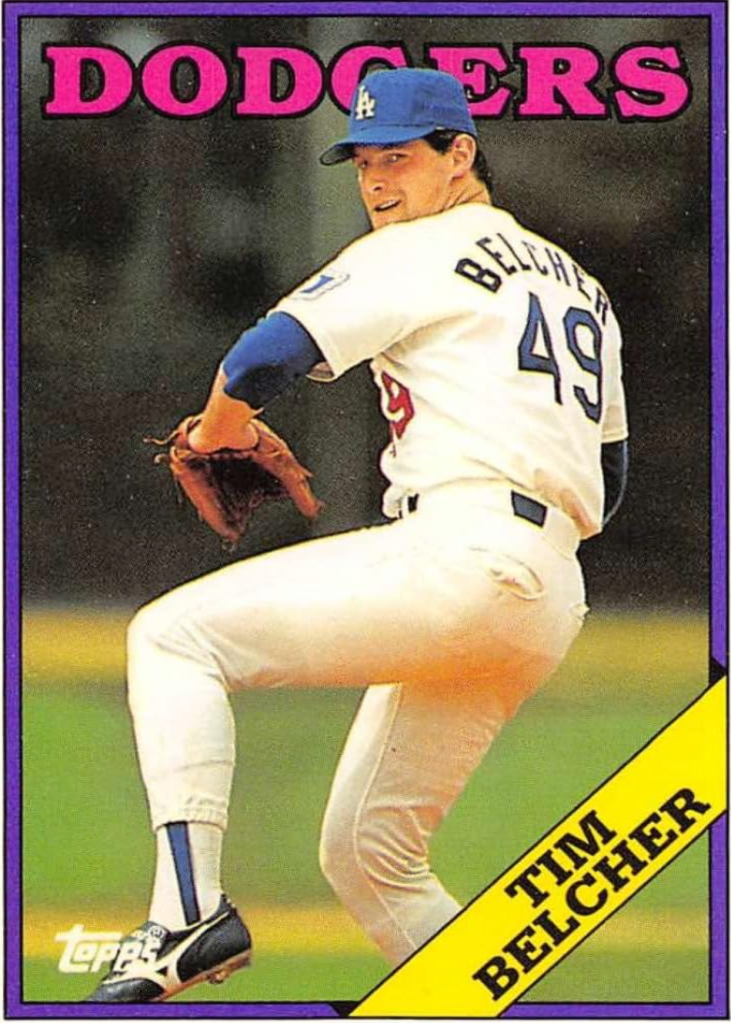
The date was August 29, 1987. Rick Honeycutt, future Dodgers pitching coach, was flushed to the Oakland A’s for the always infamous player to be named later (or, PTBN). Eight days later, September 6, the PTBN made his major league debut for the Los Angeles Dodgers, earning a win, in two innings of relief, in a 2-3, 16-inning slog with the briefly mighty New York Mets. That PTBN was named Tim Belcher.
Belcher finished out 1987 in AAA, posting a 2.38 ERA with a record of 4-2 in 6 games (5 starts). In 1988, Claire, impressed with Belcher’s fiery demeanor and obvious talent, called PTBN up to the big club to be a part of the starting rotation.
I would like to take only a brief moment to celebrate the absolute perfection, to my eight year-old brain, of a man named Tim Belcher really existing.
Winter of 1987, leading to the spring of 1988: Fred Claire worked very hard over the winter, bringing Mike Davis and Kirk Gibson in on free agent contracts. Davis chose the Dodgers over the Yankees because the Dodgers offered him $1.95 million, slightly more than Bombers*. Claire also orchestrated a massive three-team trade with Oakland and the Mets (those guys again) to bring Alfredo Griffin, Jesse Orosco, and Jay Howell into the fold.
How do I know, with the exception of signing 1988 National League MVP Kirk Gibson (I will never get tired of pointing that out), the move to get Belcher was Claire’s best move of 1987?
Mike Davis (1988):
- .196 avg, 2 HR, 17 RBI, and a shockingly bad .260 OBP. Davis would be out of baseball after the 1989 campaign, at the age of 30. He did draw one incredibly underrated base on balls in Game One of the 1988 World Series, but I digress.
Alfredo Griffin (1988):
- .199 avg, 7 SB (from a guy who stole 24, 33, and 26 the previous 3 years), a below league average fielding percentage at shortstop, and a hideous .259 OBP. He did make one very brilliant, clutch fielding play in the NLCS, but I digress.
Jesse Orosco (1988):
- A perfectly good 2.72 ERA in 55 relief appearances, 9 saves (in the pre-Bobby Thigpen days), and the inadvertent fire-lighting under the team’s ass when he put eye black inside Kirk Gibson’s hat. He didn’t throw a single pitch in the 1988 World Series, but I digress.
Jay Howell (1988):
- No slouch at all. Howell led the team with 21 saves in 1988, and improved his ERA from 5.89 to 2.08. Howell also got shit-canned in the NLCS for being caught with a foreign substance on his glove**. He locked down a save in Game 4 of the World Series, in support of Tim Belcher, but only after surrendering a walk-off HR to one Mark McGwire in Game 3.
Tim Belcher (1988):
- 12-6, 2.91 ERA (27 starts) , 1.08 WHIP, 5 complete games, 4 saves… and a 3-0 record in the postseason, including a WS Game 1 victory over the heavily favored Oakland A’s. Yes, his WS era was 6.23, but I digress.
Belcher would also be named Sporting News Rookie Pitcher of the Year for 1988. Not bad at all for a PTBN getting paid $78,000.
Belcher was absolutely indispensable for the Dodgers for the next three seasons, finishing top 10 in Cy Young voting during his sophomore campaign, when he compiled a 15-12 record in 30 starts, leading the National League with 10 CG and 8 shutouts. Overall, he went 50-38 in his Dodgers tenure, throwing 21 complete games and carrying a career ERA to that point of 2.99. It is further remarkable that Belcher did not join the list of pitchers who had their arms mutilated by Tommy Lasorda.
After the Dodgers lost the NL West on the final day of the 1991 season, GM Fred Claire set out once again to ensure that his team would not stay down for long. On November 27, 1991, Claire traded Belcher and John Wetteland to the Cincinnati Reds for Darryl Strawberry’s “best friend”, Eric Davis. I was absolutely delighted. If you look on the back of any baseball card from that era, you will understand why. The Dodgers were about to sport an outfield of Eric Davis, Brett Butler, and Darryl Strawberry. My own personal Murderer’s Row, and it was really happening!
Belcher, however, was “baffled”. He expressed concern that Claire was being too arrogant in assuming players would naturally want to play for the Dodgers (editor’s note: any player worth their salt does). Furthermore, Belcher was compelled to comment on his now former team’s roster:
“This puts them up against the 8-ball as far as getting anything for Kal (Daniels). And the pitching staff is in a state of flux. It seems like Fred’s put himself in a position of weakness with further moves, I think. But, the Dodgers have a lot of resources and it’s not unlikely they’ll get something done to fill the voids in a short period of time.”
Belcher proved to be mistaken and prescient: Eddie Murray signed with the Mets, Mike Morgan walked prior to the season and won 16 games for the Cubs. Eric Davis played 184 games in 2 seasons with the Dodgers, hitting a total of 19 home runs, and was shipped out to Detroit halfway through the 1993 season. The 1992 Dodgers lost 99 games, and were saddled the added humiliation of opening 1993 against the expansion Florida Marlins, on the road, as a reward for being the previous season’s worst team. They lost, 6-3, to 185 year-old knuckleballer Charlie Hough. The Dodgers did not get something done to fill the void. In fact, the entire decade of the 1990s proved to be one of the oddest periods in LA baseball history. Was it all the Curse of Tim Belcher?
For his part, Belcher did not thrive outside of Los Angeles. He had two highly average years in Cincinnati, going 24-20. His lowest ERA outside of Los Angeles was 3.92 (for the Royals in 1996), and he lost a league-worst 15 games for the Detroit Tigers in a strike-shortened 1994. After leaving Cincinnati, he went 72-82. Did he get Tommy’d after all? No one wins this pissing contest.
Surely, Belcher returned to Dodger Stadium a few times throughout his career, particularly during his time with the Reds. However, if we’re being totally honest, and of course we are, this is the true homecoming, the cherry on top of the PTBN sundae known as Tim Belcher.
June 5, 1999. Belcher’s last full season in the majors:
Seriously, Tim? The Angels!?
Until next time, readers. Enjoy this NL West race.
*consider this in today’s context.
**Gotta love these announcers saying Howell accidentally picked up Alejandro Pena’s glove, then immediately knowing how absurd that is.
Massive props and full credit to baseball-reference.com, the New York Times archives, and the incomparable Ken Gurnick.
 A Fool Speaks Loudest
Great write-up. I also enjoyed the fracas between Belcher and Chan Ho Park. Those Angels jerseys and logo were hideous.
LikeLike