
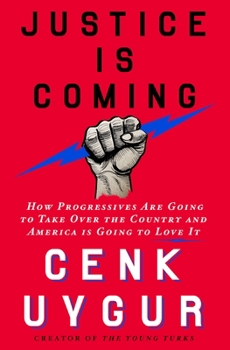
This person, me, reading this book, is like a member of the choir being preached to by his pastor. I’ve enjoyed The Young Turks (TYT) since the grainy, public access-y early days of Christian side hugs during the Bush era. I rode with author Cenk Uygur through his Al-Jazeera and MSNBC stints, I have volunteered for Wolf-pac.com (and I cannot encourage you enough to do the same, more on that momentarily), and I canvassed Modesto as a member of Alison Hartson’s campaign to unseat the odious Dianne Feinstein in 2016. I am steeped in TYT. I mention this only to demonstrate that I am absolutely biased towards the author of this book.
I wish I could get this book into the hands of the people who are not steeped in TYT and Cenk Uygur, the people who haven’t heard of him, or, even better, find him objectionable. Uygur’s explanation of media powers and motivation (spoiler: they aren’t objective reporters of truth), why Democrats have lost so much support in a country that is otherwise progressive, and where power actually lies (spoiler: not in the hands of marginalized demographics or immigrants) are undeniably persuasive and powerful. Uygur does not hide his disdain for right-wing MAGA thought, so it will be very hard to break through the cognitive dissonance happening with that 30% of the population, but it is not the media’s job to be neutral spectators. Rather, it is to call out injustice and speak truth to and about power. The feeling you have that something isn’t right, that we’re being hosed, is not unreasonable. You’re right; but don’t look down, don’t look across the table, look up. Who benefits from the status quo? Who has proven to be a fantastic return on investment for the oligarchs? What motivates corporations? Why does the media try so hard to malign policies that help people, or act like centrism is a politician’s highest virtue?
Wolf-pac.com
Get money out of politics and end legalized bribery. We are working to call a convention to amend the constitution to eliminate dark money and establish publicly-funded elections.
Brief Record Review: Kim Gordon, The Collective
Your humble narrator has been anticipating this one for quite some time. The dissolution of Sonic Youth is an absolute tragedy, but all the members have continued to soldier on individually, creating some of the best music of the 21st century. I haven’t decided if the notion that the old heads from SY are lapping the pack is a bad sign for where music is headed, but I’m also 44 years old, so the new stuff isn’t for me, anyhow.
Thurston Moore’s 2020 record Beyond the Fire was most similar to Sonic Youth’s catalog and one of the best albums I’ve ever heard (all his stuff is great, even if Demolished Thoughts makes me feel a little icky), Lee Ranaldo’s work is the weirdest, heaviest, acid-trippiest of the solo efforts (check out In Virus Times or his work with Mdou Moctar), and Kim Gordon has been on fire with Body/Head. As far as I know, this is her first “solo” work since the end of Sonic Youth, and it was worth the wait.
Kim Gordon’s contributions to Sonic Youth were dissonant lullabies, songs like “Bull in the Heather” and “Star Power” served as twinkling interludes between Ranaldo’s and Moore’s almost industrial assault. Her vocal delivery is equal parts coy whisper, children’s story time, and riot grrl wail. She’s unbelievably hip, fashionable, and everyone’s punk rock spiritual mother. So many badass ladies (Kat Bjelland, Kathleen Hanna, and Annie Clark, to name a few) have walked in her footsteps, but none have been as effortlessly cool.
This brings me to The Collective. Right off the bat, Gordon jumps out of the speakers (or even better, some decent, over-the-ear headphones) with “BYE BYE”, a mellow hip-hop song that somehow ends like “Pleasant Valley Sunday” without ever jerking you out of the vibe. I love this song, and would have absolutely worn it out in my “music for studying” playlist era. The whole record rows down this same river. “I Don’t Miss My Mind” seemed somehow familiar to me, like I’d heard it and loved it already, even though that is impossible. “Trophies” sounds like what would happen if Tune-Yards collaborated with King Buzzo for a song. I don’t know if I am personally capable of praising a track any more highly than that. “Shelf Warmer” had me nodding my head and making that angry metal face that you sometimes have to make when a track hits hard. Dude, it’s Kim Gordon. I love her.
Check out the music video for “BYE BYE”, starring Kim’s daughter, Coco. Then go to Bandcamp or a locally owned record shop and make the right decision:
Brief Film Review: When Evil Lurks
DOOD. That was one of the most harrowing movies I’ve watched in a long time.
You should know, this film was made in Argentina and is sub-titled in English. I was unaware of this going in (not sure how I didn’t know), and I almost talked myself out of watching it, but hooo whee, I am glad I chose to stick with it. In fact, I think the fact that it was made outside of the US is part of what made it so disturbing. Americans have some squeamish sensibilities, and maybe have come to expect certain storytelling devices or tropes. This film dispenses with those sensibilities and tropes in a hurry.
The first thing did as the credits rolled was turn to my wife and utter, “I think that movie was way better than Hereditary.”
Take a good look at that preview poster above. Then, go watch When Evil Lurks. Come back here after viewing it and see if you can look at that poster passively again.
Normally, I include the movie preview with my reviews here, but in this instance, I want you to go into the viewing with as little as possible prior knowledge or expectations. Just promise me you’ll watch it.
9/10
Until next time, lovely readers. Enjoy baseball season.
 A Fool Speaks Loudest